Professional Development Program
A structured course in the professional habits companies look for in freshers.
- Industry communication
- Project management
- Technical presentation
- Professional ethics
 TECHM4INDIA
Engineering imagination into impact.
05TechM4Institutes
TechM4Institutes works with colleges and universities to build industry practice into the academic calendar: credit-bearing programmes, faculty development, lab set-up and a pathway that runs from a student's first semester to placement.
01What an institution receives
Every partnership is tailored to the university's syllabus and calendar, so the programmes sit alongside existing courses instead of competing with them.
Programmes are mapped to the university's syllabus and semester calendar, so they fit B.Tech and M.Tech structures.
A Faculty Development Programme is part of the partnership, so the people who run the labs keep running them after launch.
Support for setting up software labs and licensing inside the campus, so students practise on the tools industry uses every day.
Credit-bearing programmes that slot into the academic structure: open electives, research credits and a long internship.
Guidance that moves a student from a first question to a defensible result, with a project to show for it.
Certification for students who complete a programme, and placement support for graduates.
02Academic credit programmes
PDP and RBLP together carry seven academic credits per student. LSEP adds a six-month internship on live product work.
A structured course in the professional habits companies look for in freshers.
Students work in guided teams on real deep-tech problems, from research question to prototype.
Students work on TechM4Solutions product work, writing and maintaining real code. Institutions receive an assessment rubric.
03N-STEP
N-STEP runs as a three-credit open elective that a student from any branch can join. Each track lasts twelve weeks, is mentored by industry practitioners and closes with a real project.
Supervised learning, neural networks and deploying a model on real product work.
Threat modelling, ethical hacking and security operations.
Payments infrastructure, credit scoring and regulatory technology.
Embedded systems, sensor networks, automation and smart-campus hardware projects.
CanSat mission design, orbital mechanics, space data analytics and drone payloads.
04The four-year pathway
Every year has a purpose. The pathway maps a student's growth from first-year foundations to a final-year portfolio of real work.
Semester-length programmes aligned with university calendars, so engineering students learn industry software as part of the degree.
CAD basics, BIM fundamentals, drawing standards and engineering documentation.
From modelling to analysis to design verification.
Meshing, BIM coordination, clash detection and construction documentation.
05Bootcamps for your campus
Bootcamps run at partner institutions. They are not lectures: every team leaves with something it built.
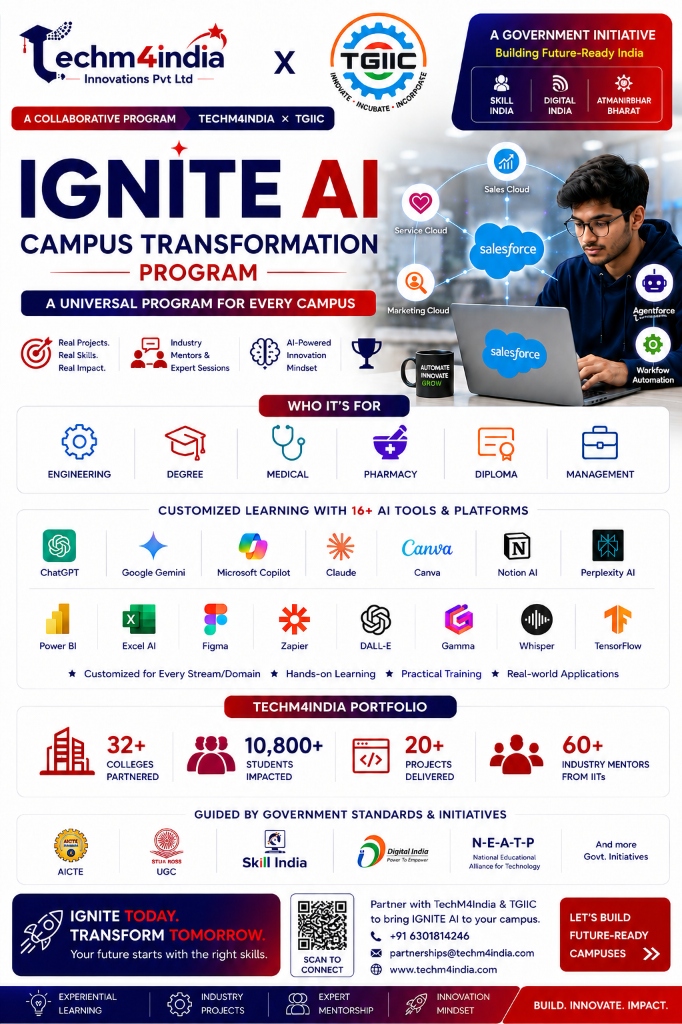
2 days, 1 night
An offline, immersive AI bootcamp for undergraduate and postgraduate students in every stream, run by TechM4India with TGIIC.
48 hours
Build and deploy a machine learning model, mentored by engineers from TechM4Solutions.
72 hours
A capture-the-flag security competition on real vulnerabilities and real systems.
3 days
Design, build, program and fly a drone payload mission.
5 days
Solve real problems from Telangana's farming communities with IoT, data and automation.
3 days
Zero to pitch: take a problem statement, build an MVP and pitch it to a panel.
4 days
Bioinformatics, genetic data analysis and biosensor prototyping for students crossing biology and computing.
We meet the leadership and faculty and learn the syllabus, the calendar and the goals.
We map programmes and credits to the university's structure.
Faculty development runs and the labs are set up on campus.
Students move through programmes, projects and bootcamps.
We review each semester with the institution and adjust what comes next.
Next step
Tell us about your institution, your branches and your calendar, and we will propose a programme that fits.